
Google reCAPTCHA April 2026 Legal Shift Explained
Feb. 27, 2026

Google has issued a mandatory service announcement to reCAPTCHA customers confirming a significant legal role change taking effect April 2, 2026. The company will transition from acting as a data controller to acting as a data processor for the reCAPTCHA service. For the millions of websites that rely on reCAPTCHA to block bots and prevent abuse, the technical experience won't change. The compliance responsibilities will.
Official Google Notice
Google issued the following notice to reCAPTCHA account holders via email in early 2026. We're reproducing it here in full for transparency.
Subject: [Legal Update] Google transitions to data processor for reCAPTCHA starting Apr 2, 2026
Hello [First Name],
We're writing to let you know that we'll be changing how we handle your data submitted to our reCAPTCHA service. Starting on April 2, 2026, we'll be switching from acting as a data controller, determining how personal data submitted to reCAPTCHA may be used, to a data processor, processing the data strictly for your use in the reCAPTCHA service. This change enables you to have greater control over how your data is used.
As part of the transition from data controller to data processor, the legal terms governing your and your customers' use of reCAPTCHA will change. Google will process your data in accordance with our Cloud Data Processing Addendum. Your end customers' use of reCAPTCHA will no longer be subject to Google's Privacy Policy and Terms of Use. The provisions in our Google Cloud Platform Service Specific Terms regarding reCAPTCHA will be updated to reflect this change.
No features or functionalities of the reCAPTCHA service will be impacted.
Action required: Starting April 2, 2026, if your website currently displays references to Google's Privacy Policy and Terms of Use in connection with reCAPTCHA, you will need to remove those references from your website.
Thanks for choosing reCAPTCHA. The Google Cloud Team
What Is reCAPTCHA?
Google acquired reCAPTCHA in 2009 from a Carnegie Mellon spin-off and has since integrated it into the broader Google Cloud ecosystem. The service functions as a bot detection and abuse prevention tool, protecting login portals, registration forms, contact forms, and e-commerce checkouts through behavioral analysis and risk scoring that distinguishes human users from automated traffic.
"reCAPTCHA is a powerful bot blocker that protects websites from spam, abuse, and fraud," according to the Google Cloud website. "It works by analyzing user behavior and other factors to determine if an action is being performed by a human or a bot. If suspicious activity is detected, reCAPTCHA may take action to prevent unauthorized access, such as presenting a challenge or blocking the interaction altogether. This helps ensure websites stay protected while minimizing interruptions for legitimate users."
The scope of this transition is substantial. According to BuiltWith technology trends data, about 10.8 million live websites currently use reCAPTCHA. Netcraft's January 2026 Web Server Survey counted more than 1.3 billion total sites globally, placing reCAPTCHA on roughly 0.8 percent of all tracked sites. Because Netcraft's count includes inactive and parked domains, the actual penetration rate among active business sites is likely considerably higher.
What's Actually Changing
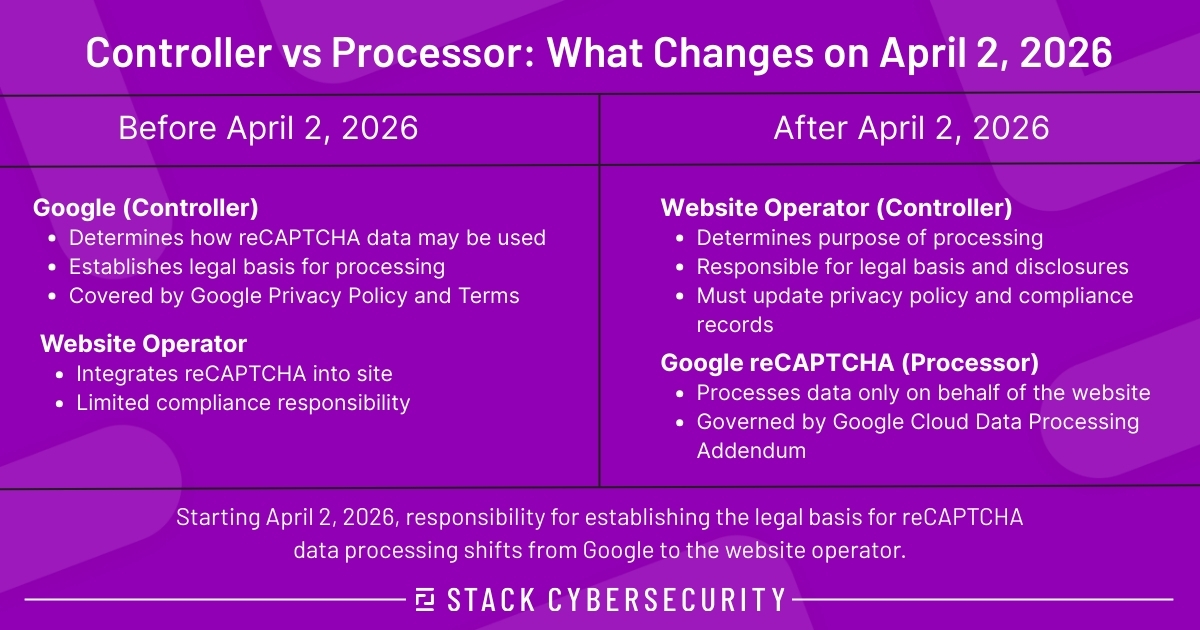
Under the current model, Google serves as the data controller for reCAPTCHA, meaning Google determines the purposes and means by which personal data submitted through the service is processed. Starting April 2, 2026, that role shifts. Google will become the data processor, handling data strictly on behalf of the website operator. The site operator becomes the data controller.
Processing will be governed by the Google Cloud Data Processing Addendum going forward. End users visiting sites that deploy reCAPTCHA will no longer have their use governed by Google's Privacy Policy and Terms of Use in this context. Website operators bear responsibility for establishing the lawful basis for that processing under applicable privacy law.
No features are being removed. No service interruption is expected. The bot detection functionality remains intact. The change is legal and structural, not operational.
Why the Controller-Processor Distinction Matters
Under the General Data Protection Regulation (GDPR) and similar privacy frameworks, the controller-processor distinction determines who bears primary legal accountability for data processing. As the European Data Protection Board stated in its Guidelines 07/2020: "The concepts of controller and processor play a crucial role in the application of the GDPR since they determine who shall be responsible for compliance."
GDPR is a comprehensive data protection law in the European Union that bolsters individuals' rights over their personal data and establishes strict guidelines for data processing by organizations.
Unlike the EU, the United States has no single nationwide data protection law. Federal privacy rules are sector-specific: the Health Insurance Portability and Accountability Act (HIPAA) governs health information, the Gramm-Leach-Bliley Act covers financial data, and the Family Educational Rights and Privacy Act applies to education records. Outside those sectors, privacy protection falls largely to the states.
California has been the most aggressive, first through the California Consumer Privacy Act and then its expanded successor, the California Privacy Rights Act, both of which give consumers rights to access, delete, and opt out of certain uses of their data. A growing number of other states have followed with their own comprehensive privacy laws, producing a fragmented regulatory landscape with no national standard.
Legal Basis
When Google was the controller, it assumed responsibility for establishing the legal basis for its own processing of reCAPTCHA data. After April 2, that accountability transfers to the site operator. Businesses that haven't thought carefully about how reCAPTCHA fits into their data inventory will need to do so now.
The timing reflects broader trends in enterprise software. As regulatory scrutiny of data collection, purpose limitation, and cross-border transfers has intensified globally, cloud providers have moved to adopt cleaner processor relationships with their clients. For Google, bringing reCAPTCHA under the same contractual framework it uses across Google Cloud also reduces friction in enterprise vendor reviews, security questionnaires, and procurement audits.
What to Do Before April 2
This isn't a situation that requires a technical response, but it does require a compliance response. Businesses should start by taking inventory of where reCAPTCHA appears across their web properties, including login pages, contact forms, checkout flows, and any third-party integrations that may embed it independently.
Privacy notices and disclosures will need to be reviewed. Any language that currently references Google's Privacy Policy or Terms of Use in connection with reCAPTCHA must be removed by the transition date. Google has explicitly stated this as a required action.
Beyond disclosure updates, businesses operating in regulated industries or under frameworks like GDPR, HIPAA, or state-level privacy laws should confirm alignment with the Google Cloud Data Processing Addendum, update their vendor risk documentation and data maps to reflect the controller relationship, and assess whether a Data Protection Impact Assessment review is warranted in higher-risk jurisdictions.
For most small and mid-sized businesses, the action items are manageable: update your privacy policy language, confirm your vendor records reflect the new DPA, and remove references to Google's Privacy Policy from any reCAPTCHA-related disclosures on your site. Companies with more complex data governance programs should consult their privacy or compliance counsel to assess broader implications.
"While some may decide to stick with Google reCAPTCHA and the Google Cloud Console, it is like gambling with privacy compliance," Friendly Captcha, a competitor, wrote on its blog. "With the April 2 deadline approaching, website operators face a choice: invest resources in making Google reCAPTCHA privacy compliant, accept the compliance risk, or switch to a trustworthy and secure CAPTCHA solution built for GDPR from day one."
Broader Lesson
This transition illustrates a pattern that compliance-focused businesses increasingly encounter: a vendor makes a legal or structural change that has no visible effect on operations but creates real accountability exposure if ignored. The reCAPTCHA change won't break any websites. But a company that misses the April 2 deadline and continues displaying outdated privacy disclosures will be out of compliance with Google's required terms and potentially out of alignment with its own privacy obligations to end users.
Staying ahead of vendor-driven compliance changes like this one is part of what a mature governance or compliance program is designed to catch. If your business lacks a clear process for monitoring third-party legal updates and translating them into internal action, this transition is a useful prompt to build one.
Related Resources
Google Cloud Security Community
Questions about how this change affects your compliance posture or vendor risk documentation? Contact the STACK Cybersecurity team to discuss your situation.